• Topic

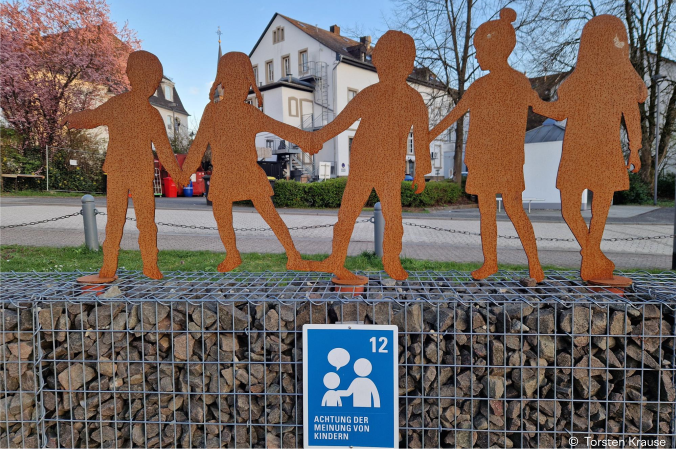
    Respect for the views of the child

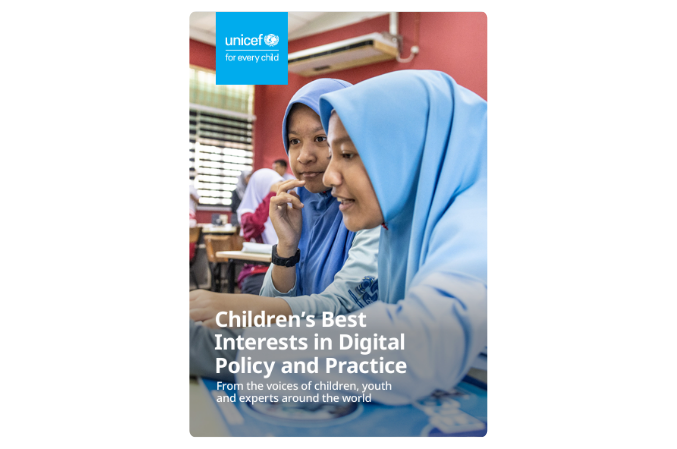
    Children reported that the digital environment afforded them crucial opportunities for their voices to be heard in matters that affected them.

    The use of digital technologies can help to realize children’s participation at the local, national and international levels.

    Therefore, awareness of, and access to, digital means for children to express their views must be promoted and support for children must be offered.

Current News

European Commission: The Digital Services Act (DSA) explained

This European Commission publication explains the Digital Services Act (DSA) in simple terms.

[Translate to Englisch:]

5Rights Foundation: Building a Digital Environment Designed with Children in Mind

The brochure presents an international blueprint for creating digital environments that respect and uphold children’s rights. Building on the UN Convention on the Rights of the Child and General Comment No. 25, it outlines how digital spaces can be designed to effectively protect and promote children’s rights. The report examines common policy approaches, identifies implementation gaps, and sets out ten regulatory principles to guide legislators in applying international best practices.

Lisbon Council High-Level Working Lunch: „To Ban Or Not To Ban”

On Monday Feb. 9th, 2026, ahead of Safer Internet Day the Lisbon Council invited a group of experts to discuss what scientific evidence and practice teach us about children and social media. In the light of the Australian experiment on banning under 16th from a certain selection of social media platforms governments around the globe are rushing to decide whether to follow the same path or find a different approach.

YOUthDIG 2026 – Call for applications!

Young people with an interest in digital issues are sought for YOUthDIG, which will take place in Brussels from May 23 to 27. In preliminary webinars, participants will address practical issues of internet governance and provide input for EuroDIG.

Joint Statement on Artificial Intelligence and the Rights of the Child

The document confirms the shared commitment to fostering an approach to artificial intelligence based on children's rights and calls for coordinated action to ensure that AI is designed, developed and governed in a way that respects, protects and fulfils the rights of the child. In addition to the United Nations organisations, the statement is also supported by more than 50 organisations, including the Digital Opportunities Foundation.

[Translate to Englisch:]

Artificial intelligence to advance children's rights

The International Telecommunication Union (ITU), the United Nations Committee on the Rights of the Child (CRC), UNICEF, the International Labour Organisation (ILO), the Inter-Parliamentary Union (IPU), UNESCO, UNICRI, UNODA, the Office of the United Nations High Commissioner for Human Rights, the Special Representatives of the United Nations Secretary-General for Children and Armed Conflict and on Violence against Children, and the United Nations Special Rapporteur on the sale, sexual exploitation and sexual abuse of children issued the Joint Statement on Artificial Intelligence and the Rights of the Child in Geneva on 19 January 2026.

A Strong Committment to Children’s Rights in the Digital Space

On Wednesday, Dec. 17th, 2025 the United Nations General Assembly have agreed on the Outcome Document of the WSIS +20 Review and established a permanent mandate for the Internet Governance Forum.

[Translate to Englisch:]

Reflecting on Four Years of General Comment No. 25

To mark the fourth anniversary of GC25, the report “The Impact of General Comment No. 25 in the UNCRC Review Process” by the Digital Futures for Children Centre in the Department of Media and Communication, in partnership with the 5Rights Foundation, was released. The report examines how General Comment No. 25 is incorporated into and implemented in current political and legal processes. Further details can be found in our article.

Child Rights Impact Assessment: A Policy Tool for a Rights-Respecting Digital Environment

Although children and young people make up about one third of internet users worldwide, their perspectives are still rarely taken into account in technology-related policies, design processes, and decision-making structures. To counter this, the authors Sonia Livingstone and Kruakae Pothong argue that a tool such as the “Child Rights Impact Assessment Tool” can serve as a practical instrument for integrating children’s rights more comprehensively, early on, and systematically into political and administrative decision-making processes.

Eurochild Position Paper: Protecting children online without silencing them

The article highlights the most important arguments and summarizes the key policy demands of the Eurochild position paper “Protecting children online without silencing them.”