
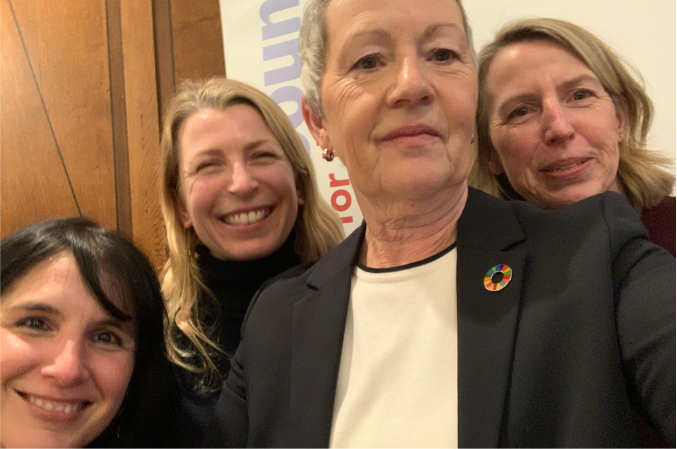
On Monday Feb. 9th, 2026, ahead of Safer Internet Day the Lisbon Council invited a group of experts to discuss what scientific evidence and practice teach us about children and social media. In the light of the Australian experiment on banning under 16th from a certain selection of social media platforms governments around the globe are rushing to decide whether to follow the same path or find a different approach. Even though Amanda Third from the Young and Resilient Research Centre at the Western Sydney University was able to give first insights into the outcomes of the ban enacted in December 2025, experts around the table claimed the need for more research and evidence of the wished for and unintended consequences of keeping children away from social media. My personal Eureka Moment occurred when Third referred to democratic values being heavily under pressure these days. How could we afford to ban young people from social media infringing their right to access to information and freedom of expression at such a crucial time? And how could we believe they would become media literate and responsible democratic citizens by magic when they turn sixteen?
What we need now is a consequent enforcement of the already existing legal framework, first of all the Digital Services Act and the platform industry acknowledging their duty of care by adherence to the Guidelines the EC have issued in July 2025.
It was my pleasure to take part in the debate, as a child rights advocate l based my reasoning on the following three questions
- What does the UN-CRC teach us?
- What do children tell us?
- What must we conclude out of that?
1) UN-CRC
According to the UN CRC children’s rights apply without any restriction to all children from birth until the age of 18, their rights are undividable and unalienable.
Art. 17 of the UN-CRC grants children the right to access to the media.
Art. 2 obliges States Parties to take all appropriate measures to ensure that the child is protected against all forms of discrimination.
Art. 3 demands that in all actions concerning children, the best interest of the child shall be a primary consideration.
Art. 5 demands that States Parties shall respect the rights and duties of parents to provide, in a manner consistent with the evolving capacities of the child, appropriate direction and guidance in the exercise by the child of the rights recognized in the UN-CRC.
2) Children’s Voices
Based on a meta-analysis of research on children’s perspectives starting from the global child participation process to General Comment #25 to the UNICEF study: Children’s perspectives on their best interests and AI, to Stoilova’s and Livingstone’s findings on perspectives from the Global South to the EU Children's Participation Platform one can summarize children’s voices as follows:
- Children around the globe appreciate being able to express themselves freely on the Internet.
- Searching for information helps them to cope with challenges they are facing in adolescence
- Social media platforms and messenger Apps help them to satisfy their need to participate and communicate with peers
- They are aware of potential risks and harms and often they struggle to manage their digital identity especially when it comes to balancing how much information they want to share about themselves online.
- They want more digital literacy education for themselves but also for their parents and teachers
- They value privacy and are aware of privacy infringement by platforms as well as by their family members
- They ask for transparent reporting mechanisms and feedback from platforms on how they handle complaints
- They place the responsibility for age-appropriate design of the services explicitly with the platform providers
- They agree to age checks although they are aware of potential infringements of their rights resulting from such disclosure of personal data.
3) Conclusion
General Comment No. 25 on children's rights in the digital environment, states in para 4, “child-friendly access to digital technologies [...] can help children exercise the full range of their civil, political, cultural, economic, and social rights.”
Today, we must acknowledge that the use of digital media is an essential element in the realization of civil rights for all people.
A general exclusion of young people below a certain age, e.g. 16 years would infringe children’s right to non-discrimination.
Undeniably those in favour of a social media ban argue based on a child’s best interest to be protected, while at the same time the best interest of the child is the reasoning of those upholding children’s rights to freedom of expression and access to information, and their right to peaceful assembly and association.
With the best interests of the child being a primary consideration in all actions concerning children and taking in account the evolving capacities of the child I conclude: Age-appropriate design of digital services based on reliable age assurance is preferable over a general exclusion of children from digital services.
Photo from left to right
Maria Soledad Pera, Associate Professor TU Delft; Leanda Barrtington Leach, 5Rights Foundation; Jutta Croll, Chair of the Board of Directors at Digital Opportunities Foundation, Germany; Leslie Miller, Vice President of Public Policy Youtube.