
The train we are supposed to board next year with our ticket safely stored in the European Digital Identity Wallet is future bound. This is one of the take aways from the European Dialogue on Internet Governance – EuroDIG 2026. The conference was designed to take a look back and forward in Internet Governance based on the WSIS+20 review process and the 20th anniversary of the Top-Level-Domain .eu. In her keynote Henna Virkunnen, Executive Vice-President European Commission celebrated the success story of EURID, the European Registry for .eu as a stark signal of Europe’s tech sovereignty in the global internet. Thereby she opened a discussion on sovereignty as a term that was continued in the session on “The European Approach to Digital Sovreignty“. Although there is no common understanding of the term sovereignty, with interpretations stretching from independence to autonomy there was a consensus dependencies in general may cause strategic vulnerabilities that result in threats to our common democratic values. Europe’s strategy to avoid and overcome such dependencies and to achieve (more) digital sovereignty demands for European collaboration among trusted countries set against the dominance of tech giants and so called hyper scalers.
When in 2003 and 2005 the World Summit on the Information Society took place in Geneva and Tunis the world has been different and hopes were high the Internet would be able to pave the way to democracy and equal opportunities around the globe. The review process undertaken in 2025 was taking stock of the achievements towards the WSIS Action Lines and culminated in the WSIS+20 Outcome Document (UNGA Resolution A/RES/80/173) adopted by the UN General Assembly by consensus in December 2025. With that the UNGA provided a permanent mandate for the global Internet Governance Forum which is both, acknowledgement and obligation for the IGF and, as a consequence also for national and regional initiatives like the European Dialogue on Internet Governance – EuroDIG. The implementation of the WSIS +20 review outcomes therefore were discussed in two sessions stressing the need for further collaboration.
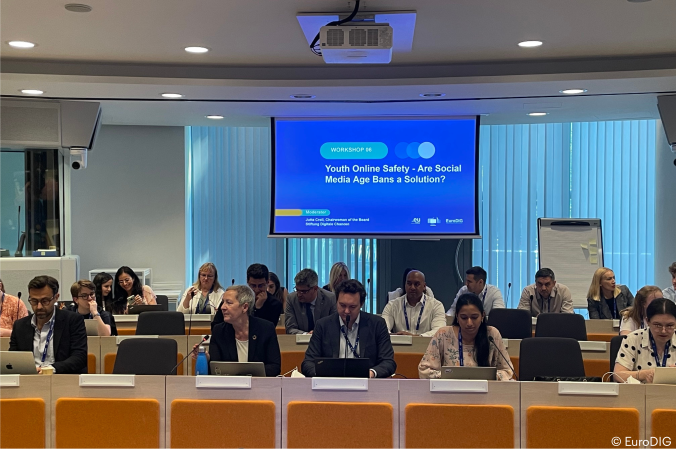
Also, the European Digital Identity Wallet (EUDI-Wallet) was discussed at EuroDIG 2026 as having the potential of being key to more digital sovereignty, while significant efforts are necessary to achieve a broad uptake by European citizens. In the workshop “Youth Online Safety – Are Social Media Age Bans a Solution?” again the EUDI-Wallet came into play. Diya Aravinthan, Lennart Wetzel, Carmela Troncoso and Andrea Tognoni discussed on the panel the role of technology to ensure a high grade of privacy, safety and security for minors online like the Digital Services Act, Art. 28 demands from platform providers. The Art. 28 Guidelines although not binding are considered quite useful to support platforms in creating a safer digital environment, said Lennart Wetzel, Senior Manager for EU Public Policy at Snap. He underlined Snap’s focus on child online safety being evidenced by the huge number of 450.000 profiles of minors they deleted after the social media ban for under 16ths came into force in December in Australia. Diya Aravinthan, Youth Ambassador in the BIKplus programme stressed a blanket social media ban for underaged children risks being an oversimplifyed approach to a complex challenge. What we need is an effective and proportionate solution, she said.
Carmela Troncoso, Scientific Director at Max Planck Institute for Security and Privacy in Lausanne cautioned technical measures to implement age bans can be very privacy invasive and they are known to be easily circumvented. In accounting “gains and harms” of social media bans she concluded from a security perspective platform regulation would have a better ratio of gains and harms than social media bans, having in addition also positive effects on the mental health of adults.
Andrea Tognoni, case handler in the DSA Protection of Minors and Other Societal Risks Unit of DG Connect pleaded to put children’s rights at the centre of the debate and consider potential age restrictions not in isolation but within the current policy and regulatory context.
Participants in the room demanded a safety-by-design approach as the DSA guidelines recommend platform providers to implement should be accompanied by digital literacy training for children as well as for their parents and teachers. There was a broad consensus that instead of a blanket social media ban for minors providing users with digital services and content appropriate for their respective age is the preferred way forward. Since age verification is a pre-condition to doing so, the wallet that EU Member States are obliged to provide for their citizens as of January 2027 comes along with high expectations on data minimizing and privacy preserving age assurance.