European Commission: Survey on the Digital Fairness Act

The European Union wants children and teenagers to have safe and positive experiences when using apps, websites, games and social media, so it is creating a new law called the Digital Fairness Act. To help shape this law, the EU wants to hear from children and teenagers aged 12 to 17 about their experiences as consumers, including how apps and websites treat them when they choose, use or pay for things online. Your views will help make the digital world fairer for everyone your age.

[Translate to Englisch:]

Human rights impact assessment is being incorporated into ICANN processes

From 7 to 12 March, the multi-stakeholder community gathered at the ICANN 85 Community Forum in Mumbai (India). Together, they discussed current issues and developments relating to the security and further advancement of the Internet. From the perspective of the “Child Protection and Children’s Rights in the Digital World” project run by the Digital Opportunities Foundation, the focus was on efforts to develop and implement a human rights impact assessment, as well as on the upcoming decision-making process regarding the handling of urgent requests in the context of the Registration Data Request Service (RDRS). In addition, the drafting of a Policy Development Process (PDP) for dealing with DNS abuse was a key priority.

[Translate to Englisch:]

Addressing Children´s Rights at the DNS

From 7 to 12 March, the multistakeholder community will meet in Mumbai, India, for the ICANN 85 Community Forum to discuss current issues and developments related to the security and advancement of the Internet. Among other things, the focus will be on the (continued) work on universal acceptance, the development and implementation of a human rights impact assessment (HRIA) within ICANN structures, and the use of the domain name system. Many bodies will also discuss further preparations for the new generic top-level domain (gTLD) program. An overview of the main topics of the event can be found here.

[Translate to Englisch:]

Commission holds first meeting of Special Panel on child safety online

Today, European Commission President Ursula von der Leyen hosted the first meeting of the Special Panel on child safety online. The panel, announced in the 2025 State of the Union address, will provide expert recommendations to better protect and empower children online and will explore the need for potential harmonised age restrictions to access social media.

Age Restrictions on Social Media – What Can We Learn from the Australian Model?

Political intention to introduce age restrictions on social media is intensifying across Europe. Several European Union member states are advancing national initiatives, reflecting growing concerns about the impact of social media on minors. France, Denmark, Greece and Spain are among the countries that have announced or introduced measures to restrict social media use by under-18s. - At the European supranational level, the debate is also gaining momentum. The European Union has set up a panel of child protection experts to advise on possible EU-wide age restrictions, with recommendations expected by the end of the summer.

(c) IGF 2026

IGF 2026: Call for thematic input

From now until February 28, 2026, 23:59 (UTC), it is possible to submit thematic contributions that are to be given priority consideration at the Internet Governance Forum (IGF) 2026. Organisations and individuals can use a form to select topics that they feel are currently relevant to internet governance.

[Translate to Englisch:]

Artificial intelligence to advance children's rights

The International Telecommunication Union (ITU), the United Nations Committee on the Rights of the Child (CRC), UNICEF, the International Labour Organisation (ILO), the Inter-Parliamentary Union (IPU), UNESCO, UNICRI, UNODA, the Office of the United Nations High Commissioner for Human Rights, the Special Representatives of the United Nations Secretary-General for Children and Armed Conflict and on Violence against Children, and the United Nations Special Rapporteur on the sale, sexual exploitation and sexual abuse of children issued the Joint Statement on Artificial Intelligence and the Rights of the Child in Geneva on 19 January 2026.

[Translate to Englisch:]

Call for applications: Microsoft is looking for young people for the AI Futures Youth Council

With the opportunity to get involved in the development of AI products and policies, Microsoft is reaching out to young people between the ages of 13 and 17. The goal is to establish a youth council (AI Futures Youth Council) consisting of 20 members.

A Strong Committment to Children’s Rights in the Digital Space

On Wednesday, Dec. 17th, 2025 the United Nations General Assembly have agreed on the Outcome Document of the WSIS +20 Review and established a permanent mandate for the Internet Governance Forum.

Ansicht: EuroDIG 2025: Aufruf zur Programmgestaltung

Preparation for EuroDIG has launched

Preparations for the European Dialogue on Internet Governance (EuroDIG) 2026 have begun. Proposals for the thematic structure of the programme can be submitted until 31 December 2025.

Shaping the digital future in line with human rights

The ICANN community will meet in Dublin, Ireland, from 25 to 30 October to hold its annual general meeting. The conference will focus on the further development of policies and processes by the ICANN community.

Personal Integrity: Thinking beyond the protection of minors

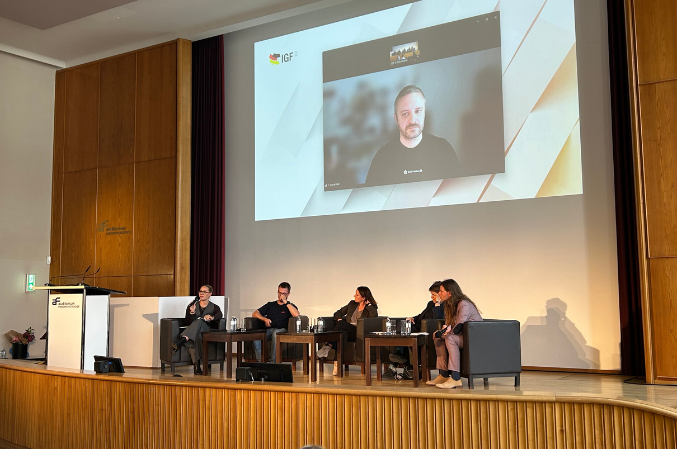
On 10 September, the Internet Governance Forum Germany (IGF-D) met in Berlin to discuss current issues and developments in the governance and regulation of the internet. Under this year's motto, ‘Trust, Responsibility, Networking: Internet Governance in Uncertain Times,’ representatives from the fields of politics, business, technology, civil society, science and research, as well as youth, met in their national structure (NRI)to reflect on relevant aspects from a German perspective.

Show all news