The photo shows a little boy holding a cell phone. He has black hair and is seen from behind.

AI governance must take children’s rights into account

On the occasion of the United Nations General Assembly, to be held from 22 to 28 September 2026 in New York (USA), more than 125 organisations and experts are reiterating their joint statement on children’s rights and artificial intelligence. They had already drawn attention to these issues at the Global Dialogue on AI Governance in July 2026 in Geneva (Switzerland), emphasising that children’s rights in relation to the digital environment must also be applied in the context of artificial intelligence as set out by the United Nations Committee on the Rights of the Child in 2021 in its General Comment No. 25 on the Convention on the Rights of the Child.

In the picture, you can see seven teenagers. They are looking down. They are holding a cell phone. They are looking at their cell phones.

Survey for the EU Youth Dialogue

The 2026 consultation phase for the EU Youth Dialogue has begun. The 12th Youth Dialogue, which facilitates the participation of young people in the European Union, focuses on European Youth Goal No. 4: Information and Constructive Dialogue. To this end, the perspectives of young people who can share their experiences in the digital world are sought. Topics include social media and artificial intelligence.

[Translate to Englisch:]

Open letter calls for stricter regulation of platforms

With regard to Commission President Ursula von der Leyen’s State of the European Union address, 144 organisations and supporters have published an open letter. In the letter, they call on the European Commission to hold digital service providers more accountable and to ensure that platforms are designed to be safe for children by default.

[Translate to Englisch:] (c) Torsten Krause

Minister Prien announces action plan on recommendations

Following a year of intensive work, the work of the expert commission on ‘Child and Youth Protection in the Digital World’ culminated in a closing event on Friday, 11 September 2026. At this event, the two co-chairs of the expert commission, Nadine Schön and Prof. Olaf Köller, jointly presented the final report to Federal Minister for Family Affairs Karin Prien.

Age Assurance Can Only Be Part of the Solution

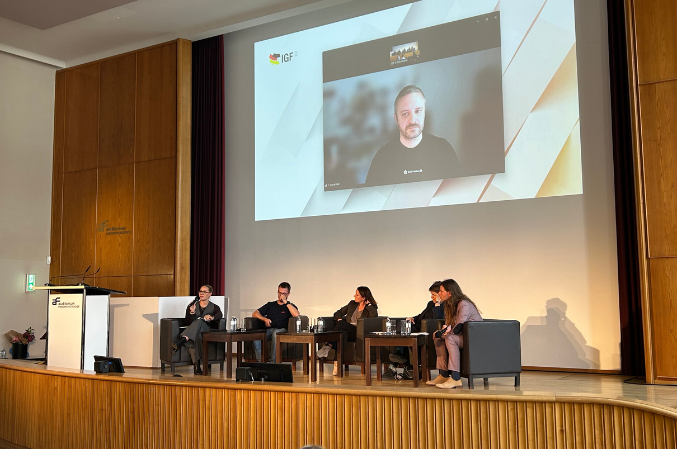
For some time now, there has been discussion about using corresponding online age-assurance mechanisms to protect young people, including those significantly below the age of majority, from certain risks. How this could be achieved, and whether age assurance can provide a solution for child and youth protection on the internet, were discussed on 9 September at the Internet Governance Forum Germany (IGF-D) in the panel discussion “Tell Me Your Age First… Online Age Assurance Between the Protection and Participation Needs of All.”

Together for a Better and Safer Internet

The Federal Ministry of Education, Family Affairs, Senior Citizens, Women and Youth has published the report “Together for a Better and Safer Internet” on child and youth participation for the Expert Commission in German language. The report documents the workshops held as part of the project “Child Protection and Children’s Rights in the Digital World”, which took place in spring 2026 with children and young people aged between 12 and 17, and brings together the suggestions, ideas and wishes of the young participants in 70 recommendations. These were presented to the expert commission on 7 May 2026.

[Translate to Englisch:]

The Children are alright!

Den Kindern geht es gut, auch im digitalen Umfeld: Das muss das zeitnahe Ziel der politischen Maßnahmen zur Umsetzung der Handlungsempfehlungen des europäischen Special Panels für die Onlinesicherheit von Kindern sein. Damit ist die Richtschnur des politischen Handelns gesetzt, diese Entscheidungen müssen – so wie es Artikel 3 der UN-Kinderrechtskonvention vorgibt – im besten Interesse der Kinder getroffen werden.

[Translate to Englisch:]

European Commission: Children’s rights must be taken seriously

The Special Panel on Child Safety Online today presented its recommendations to the President of the European Commission, Ursula von der Leyen. In their report, the experts examine how children and young people grow up in the digital environment, highlighting its advantages and disadvantages, and propose a framework based on the developmental stages of young people. The German expert commission on ‘Protecting Children and Young People in the Digital World’ has already taken a similar approach, having submitted its report to the German government just under three weeks ago.

IGF 2026: Call for Session Proposals

Kenya will host the 21th United Nations Internet Governance Forum (IGF) from 14 to 18 December 2026. For the first time since the United Nations General Assembly made the mandate permanent, participants from stakeholder groups representing government, private sector, technical community, intergovernmental organisations and civil society will gather in Nairobi. Together, they will discuss current issues and challenges relating to the shaping of the digital environment under the overarching theme ‘Governing the Internet in the Age of Intelligence: Our Shared Responsibility.

[Translate to Englisch:]

Expert Commission: The digital world must be child-friendly

After 9 months of intensive work, the expert commisison on "Protecting Children and Young People in the Digital World" today presented its recommendations to Federal Minister for Youth Karin Prien. On 4 September 2025, she had appointed eighteen experts from various professions and mandated them to develop a strategy for the protection of young people online, including specific recommendations for action for various stakeholders such as the federal government, the Länder (federal states) and civil society.

[Translate to Englisch:]

Consider children's rights in relation to new gTLDs

The multi-stakeholder community gathered in Seville, Spain, for the ICANN Policy Forum from 8 to 11 June to continue discussing current issues and developments regarding the structuring and safeguarding of the internet. The “Child Protection and Children’s Rights in the Digital World” project run by the Digital Opportunities Foundation has been actively involved in the ICANN community for years, working to ensure that aspects of child protection, in particular, are taken into account within the Domain Name System (DNS).

[Translate to Englisch:] (c) pixabay via canva.com

Principles for a safe online environment for children

The G7 Digital and Technology Ministers (Germany, France, Italy, Japan, Canada, the United Kingdom of Great Britain and Northern Ireland, and the United States of America) have, for the first time, defined a common set of principles for a safer and more secure digital space for minors. They call on digital service providers to use these principles as a guide for the design of their services and to work with the necessary partners to implement them.

Show all news